
A few weeks ago I filled out a lead form at a longevity clinic. I was interested in their hormone and peptide programs. Nobody called me back.
I was in the area anyway, so I walked in.
I got a hello and a “how can I help you?” I asked about their TRT program and said I had questions about peptides. The front desk said hold on, walked to the back, and came out with a nurse.
The nurse said hi — and started walking me around the clinic. Here’s the IV room. Here’s HBOT. Here’s aesthetics. Red light. Room after room. Then she began telling me about pellets. At the end of the tour she told me it was $350 down and $199 a month, and that I could use the InBody whenever I came in.
Here is the part that matters. I was already on injections — I was looking for a clinic to continue what I was doing, and to talk to someone about peptides.
And this clinic did injections. They had exactly what I came for, sitting right there in the building.
She talked to me about pellets anyway. Not because pellets were right for me — she had no idea what was right for me — but for the reason it usually is: that’s what she personally likes. One question would have redirected the entire conversation. What are you on now?
I said I’d think about it, and I left.
No name. No number. No follow-up appointment. They already had my contact information sitting in a lead form nobody called — and they let me walk out the door without asking for it again.
The Short Version
Nobody asked me why I was there. That isn’t a people problem — it’s what happens when a clinic has no system for it. Most longevity clinics are built to present services, not to discover needs, so a well-meaning employee shows every room and recommends whatever the clinic happens to sell. The tour is not the sale. The tour is what you do after you understand why someone walked in. Three changes fix most of it: call every lead form immediately, never tour anyone who hasn’t completed a discovery form, and never showcase a single room until you know what that person came in to solve.
They Sold the Clinic. Nobody Sold Me Anything I Needed.
Think about what actually happened in that visit.
I told them, out loud, that I was interested in TRT and had questions about peptides. That is a specific person with a specific problem, already in treatment, actively shopping for a clinic. In response, I was shown an IV room, a hyperbaric chamber, an aesthetics suite, red light therapy, and a body composition scanner — and then talked to about a delivery method I hadn’t asked about and didn’t want.
Not one question came back at me. Not what are you currently on? Not what made today the day you walked in? Not who’s been managing your levels? Nothing.
And remember: they offered injections. The answer was in the building. A ninety-second discovery conversation would have surfaced an existing TRT patient on injections, shopping for a new home, with money in hand and specific peptide questions — close to the easiest patient a longevity clinic will ever see. They didn’t lose me because they lacked the service. They lost me because nobody asked.
This is the drift that kills clinics quietly. A staff member stops recommending what the patient needs and starts recommending what they would choose. It never feels like a sales failure from the inside — it feels like enthusiasm. It is invisible to the person doing it, and it is obvious to anyone auditing from outside. Which is precisely why somebody has to be auditing.
That nurse was not being lazy, and she was not a bad employee. She was being helpful in the only way anyone had ever shown her. I’d bet the clinic has no workflow for a walk-in, no discovery form, no rule about who gives a tour and when, and no follow-up sequence for a lead form that never got called. She did exactly what a well-meaning, untrained person does: she showed me everything, because nobody ever taught her how to find out what I needed.
Longevity clinics are built to present services. Almost none are built to discover needs — and then customize the clinic to the person standing in front of them.
What Should Have Happened
Three rules. None of them cost money, and none of them require software.
- Every lead form gets called immediately. Not tomorrow. Not when someone gets a minute. A person who fills out a form on a longevity clinic’s website has raised their hand at the exact moment they were ready. That window closes fast, and every hour it stays open, someone else’s clinic is calling them.
- Nobody gets toured without completing a discovery form. Walk-in or scheduled, it doesn’t matter. The form is not paperwork — it is the map. Without it, whoever walks the patient around is guessing.
- No tour happens until the person giving it understands why the patient came. What they want. What they’ve already tried. What made today the day. Then you show them the parts of the clinic that solve it — and only those parts.
Run it that way and the whole visit inverts. Instead of a stranger being walked past six rooms she has no use for, you have a patient hearing about the two services that address the exact thing she came in worried about. That is not a tour. That is a recommendation, and it closes.
The Patient Journey Is a Circle, and They Ran It Backwards
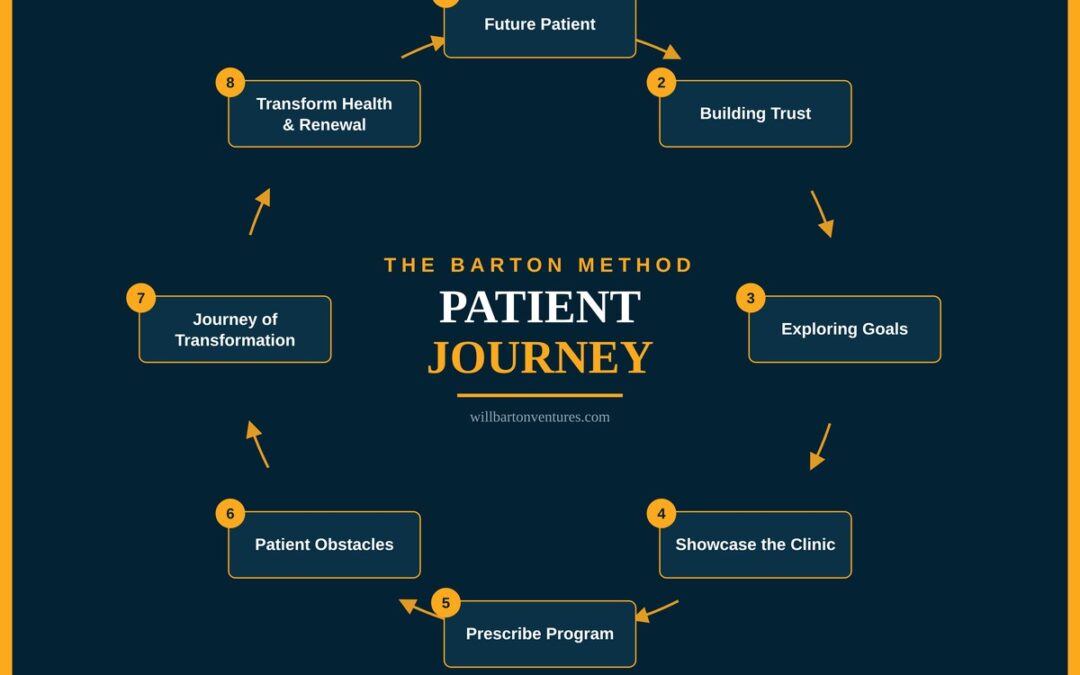
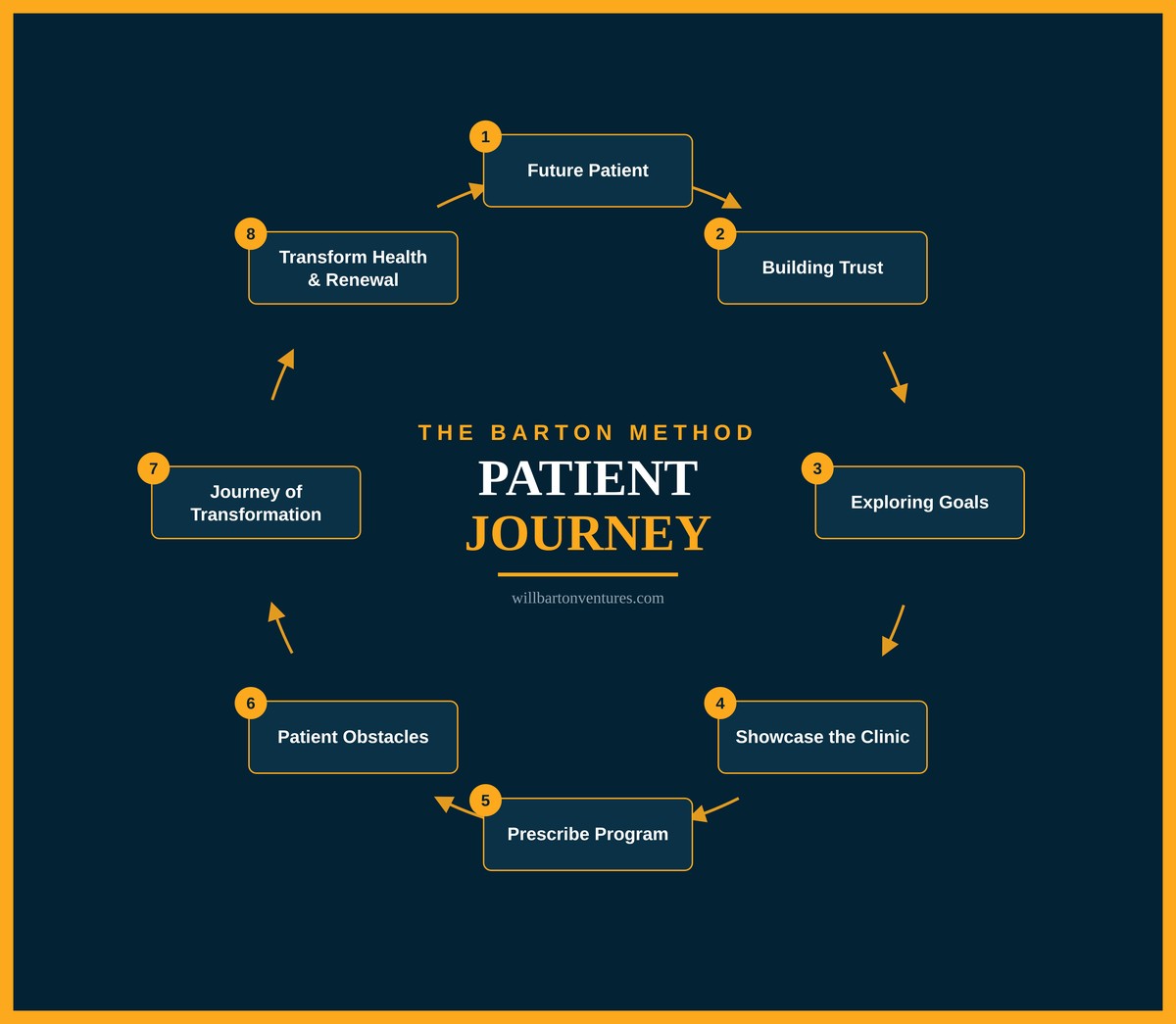
This is the sequence I’ve built and refined over twenty years. Eight steps, in order, every patient, every time.
Now look at what that clinic actually did to me.
They skipped step 1 — I was a future patient who raised his hand on a form, and nobody called. They skipped step 2, building trust, because “hold on” and a handoff to a stranger is not trust. They skipped step 3 entirely: nobody explored my goals, because nobody asked me a single question.
Then they opened at step 4 — showcase the clinic — and went straight to step 5, prescribe the program, quoting me pellets and a price. Prescribing before diagnosing. In a medical clinic.
Steps 6, 7, and 8 never happened at all. Nobody surfaced an obstacle, nobody laid out a journey, and there was no renewal to speak of — because I walked out and they didn’t have my name.
The showcase is step four for a reason. Run it first and you are pitching a stranger. Run it fourth and you are answering a person.
Why This Keeps Happening
Because almost no longevity clinic has a training program, a workflow, and a follow-up for every KPI in the business.
That is not a criticism of the people working in them. It’s the opposite. That nurse would probably have run a beautiful discovery conversation if anyone had ever taught her one existed. The front desk would have called my lead form if calling lead forms were somebody’s job, with a number attached, that somebody reviewed.
What a clinic actually needs, underneath the org chart, is this — for every single seat in the building:
- A workflow — what this person does, step by step, in the situations they will actually face.
- A training — a real curriculum, not a tour and a login. The onboarding I build runs nineteen modules, and that’s day one. Culture first, then the science, then the method, then the seat.
- A follow-up — the step almost everyone skips. Great service is a method, not magic, and the follow-up is where the magic lives.
- A KPI — one number that person owns. Not a job title and a shrug.
Miss any one of the four and you get exactly what I got: a well-meaning employee, improvising, in a beautiful building, losing a patient who had already told them he was ready to buy.
The Numbers a Systemized Clinic Hits
Run the journey in order, with a trained team, and this is what the funnel looks like. These are the benchmarks I use to find the broken step in a clinic that isn’t hitting them.
| Step in the Journey | Benchmark |
|---|---|
| Inquiry calls booked into a consult | 70% goal · 80% avg |
| Bookings made within 48 hours of first contact | 95% |
| Non-bookings followed up within | 24 hours |
| Booked consults that show | ~85% |
| Showed consults that start a program | 88–92% |
The diagnostic power is in which line fails first. Under 70% booking is a phone problem. Under 85% showing usually means the booking was weak. Under 88% closing is a consult problem — thin discovery, or a showcase that happened before anyone knew what the patient needed. And if all four look healthy and volume is still soft, then and only then do you have a marketing problem.
The clinic I walked into could not have told you a single one of these numbers. I would bet on it.
Why I Built the Barton Method
I’ve been crafting this system for more than twenty years. It was the foundation of building one of the most successful medical weight loss companies in the United States, and I’ve used it across 50 businesses in medical wellness, weight loss, longevity, anti-aging, and fitness.
It exists for exactly the reason I walked out of that clinic. Not because the people were bad — they weren’t. Because nobody had built them a system, and without one, even good people default to showing the features.
Service, not sales. The close is a by-product of listening. A patient who has been genuinely heard doesn’t need to be sold, and they don’t walk out saying they’ll think about it. They become the raving fan who sends you three more.
Monday Morning
- Check your lead forms. How many came in last month? How many were called within an hour? If you don’t know, that is the answer.
- Have someone walk in off the street and ask about your programs. Then find out what actually happened to them.
- Write the walk-in workflow. Who greets them, what gets asked, what form gets completed, and who is allowed to give a tour — and when.
- Put a number on every seat. If a position has no KPI, nobody is accountable for the thing it was hired to do.
Then fix the step, not the symptom.
Will Barton Ventures
If you don’t have a training, a workflow,
and a follow-up for every KPI in your business,
you don’t have a system.
Boutique firm — limited clinics per quarter.
Frequently Asked Questions
Why do longevity clinics lose patients who walk in ready to buy?
Because they showcase the clinic before they understand the patient. A prospective patient who asks about a specific program gets walked past every room and service instead of being asked why they came, what they have already tried, and what they are trying to solve. The tour becomes a feature list rather than a recommendation, and the patient leaves saying they will think about it. The fix is sequence: discovery first, showcase fourth.
Should a longevity clinic tour a walk-in patient?
Not immediately. No one should be toured before completing a discovery form, and no tour should begin until the person giving it understands why the patient came in. Once that is known, the tour stops being a walk past six rooms the patient has no use for and becomes a targeted demonstration of the two or three services that address their actual goal.
What does a longevity business consultant actually do?
Builds the operating system a clinic is missing: the patient journey from first contact to renewal, an org chart with defined seats, and for every seat a documented workflow, a training curriculum, a follow-up cadence, and a KPI that someone owns. Then measures the funnel — booking rate, show rate, close rate, retention — to locate the specific step that is broken, and fixes that step rather than the symptom it produces.